
Menopause hormone therapy, often called HRT or MHT, usually means estrogen to relieve symptoms like hot flashes and night sweats, and sometimes progesterone (or a similar progestogen) to protect the uterine lining if you still have a uterus. Hormone therapy is the most effective treatment for vasomotor symptoms and it also helps prevent bone loss and fractures, but risks and benefits change based on your age, how long it has been since menopause, the dose, and the route you use.
Timing matters: For women who start HRT near menopause onset—typically under age 60 or within 10 years of menopause—the benefit-risk profile is generally most favorable. This timing context is important because it means route isn’t the only consideration when thinking about safety.
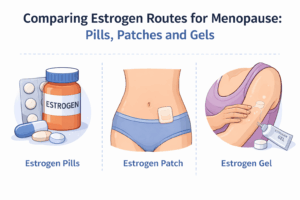
The three common ways to take systemic estrogen are pills (oral), patches (transdermal), and gel (transdermal). They can all work well for symptom relief. The main difference is how your body processes the hormone, which affects side effects and certain risks.
1. Pills (oral estrogen)
What it is: A tablet you swallow, usually once daily. It delivers estrogen into your digestive system and then your liver processes it before it reaches the rest of your bloodstream.
How it works: Because oral estrogen goes through the liver first (called “first-pass metabolism”), it tends to increase certain liver-produced proteins. This can change clotting factors and other blood markers. ACOG notes that oral estrogen may have a prothrombotic effect, meaning it can push blood toward clotting more than transdermal routes.
What it can be good for: Some people prefer a daily pill routine. It can work well for hot flashes, night sweats, and other systemic symptoms, just like patches and gel.
Common drawbacks: Oral estrogen is the route most consistently linked to higher risk of venous thromboembolism (blood clots in the veins) compared with transdermal estrogen in observational research. One meta-analysis of 15 observational studies found that compared with transdermal estrogen therapy, oral estrogen therapy was associated with higher risk of a first VTE episode (relative risk 1.63, 95% CI 1.40 to 1.90) and higher risk of DVT (relative risk 2.09, 95% CI 1.35 to 3.23).
2. Patches (transdermal estrogen)
What it is: A medicated patch you apply to your skin, commonly replaced once or twice a week depending on the product.
How it works: The estrogen absorbs through the skin directly into the bloodstream. It largely avoids first-pass liver metabolism. This is the key reason specialists often prefer it when clot risk matters.
What it can be good for: Patches provide steady hormone levels for many users. They are also practical if you do not want to remember a daily pill.
Common drawbacks: Some people get skin irritation from adhesives or struggle with patches staying on (sweat, heat, swimming, friction). Those issues are real, but they are usually manageable by rotating sites and choosing a formulation that suits your skin.
Safety signal: High-quality guidance and large studies consistently report lower clot risk with transdermal estrogen than with oral estrogen. NICE states that VTE risk is not increased with transdermal HRT and that VTE risk is increased with oral HRT. NAMS also notes that observational studies have not demonstrated an increased VTE risk with transdermal estrogen therapy and suggests lower risk with transdermal routes. A large UK study in the BMJ reported that, compared with transdermal HRT, oral HRT was associated with a 70% increased risk of VTE (odds ratio 1.70, 95% CI 1.56 to 1.85).
3. Gel (transdermal estrogen)
What it is: Estrogen in a gel you apply to the skin daily, usually on the arms, thighs, or shoulders depending on the product instructions.
How it works: Like patches, gel delivers estrogen through the skin into the bloodstream and largely avoids first-pass liver effects.
What it can be good for: Gel gives you flexibility in dosing and can be a strong option if you react to patch adhesives or you want a transdermal route without wearing a patch.
Common drawbacks: You need to apply it correctly and let it dry. There is a practical concern about transferring the medication through skin-to-skin contact before it fully dries, so many clinicians advise avoiding contact with that area until it is dry and covered. This is not a reason to avoid gel, but it is something you must use correctly.
Safety signal: Because gel is transdermal, its clot-risk profile aligns with the broader evidence and guideline statements that transdermal estrogen has lower VTE risk than oral estrogen.
Key differences that matter most
A) How your body processes estrogen
Pills go through the liver first, which triggers that first-pass metabolism effect. Patches and gel largely bypass the liver and deliver estrogen directly into the bloodstream. This fundamental difference in processing is the main reason transdermal estrogen is often considered safer for clot risk.
B) Blood clot risk (VTE) and possibly stroke
Across multiple large observational studies and meta-analyses, oral estrogen shows higher VTE risk than transdermal estrogen. The 2015 meta-analysis reported RR 1.63 for VTE with oral compared with transdermal. The BMJ 2019 study found oral HRT had higher VTE risk than transdermal (OR 1.70). NICE explicitly states VTE risk is not increased with transdermal HRT and is increased with oral HRT. NAMS states transdermal routes and lower doses may decrease VTE and stroke risk.
Understanding absolute vs. relative risk: While oral estrogen increases VTE risk relative to transdermal routes, it’s important to know that the absolute risk for healthy women without major risk factors remains relatively low. That said, transdermal is still preferred when minimizing this risk, especially if you have individual risk factors.
C) Individual risk factors matter
Personal VTE risk factors—such as obesity, personal or family history of clots, thrombophilia, immobility, or smoking—should strongly influence your choice. Women with these risk factors have even stronger reasons to prefer transdermal routes.
D) Hormone level steadiness and day-to-day use
Patches tend to provide more stable levels across the week for many people, depending on the patch schedule. Gel can also provide stable levels, but it depends on consistent daily application. Pills are convenient for people who prefer a daily medication routine, but some people notice more fluctuation.
E) Side effects and practical fit
Pills: simple routine, but may be less attractive if you have risk factors for clots or prefer to avoid liver effects.
Patches: low maintenance, but possible adhesive irritation and wear issues.
Gel: no adhesive, flexible dosing, but daily application and drying time matter.
Which one is suggested as safest overall
If you look at what major guidelines and large studies repeatedly emphasize, transdermal estrogen—meaning patch or gel—is generally considered the safest systemic estrogen route for most women when you focus on clot risk. NICE says VTE risk is not increased with transdermal HRT and is increased with oral HRT. ACOG highlights that oral estrogen may have a prothrombotic effect while transdermal estrogen has little or no effect on prothrombotic substances. NAMS notes transdermal routes and lower doses may decrease VTE and stroke risk.
One more point many people miss: estrogen route is only half the plan
If you still have a uterus, you typically need progesterone or another progestogen along with systemic estrogen to protect against endometrial hyperplasia and cancer. This need does not go away just because you choose gel or a patch. The overall safety profile depends on the complete regimen—meaning estrogen type, dose, route, and whether and how you use endometrial protection.
The type of progestogen matters too: Observational data suggests that micronized progesterone may have a more favorable safety profile compared to some synthetic progestogens, particularly regarding breast tissue effects. This is another reason why discussing the full regimen with your clinician is important—not just the estrogen route.
Abbreviations:
∙ HRT = Hormone Replacement Therapy
∙ MHT = Menopausal Hormone Therapy
∙ VTE = Venous Thromboembolism (blood clots in the veins)
∙ DVT = Deep Vein Thrombosis (a blood clot in a deep vein, usually in the leg)
∙ CI = Confidence Interval (a statistical range that likely contains the true value)
∙ RR = Relative Risk (compares the risk of an event between two groups)
∙ OR = Odds Ratio (another way to compare risk between two groups)
∙ ACOG = American College of Obstetricians and Gynecologists
∙ NICE = National Institute for Health and Care Excellence (UK)
∙ NAMS = North American Menopause Society
∙ BMJ = British Medical Journal
Sources:
1. American College of Obstetricians and Gynecologists. ACOG Committee Opinion No. 556: Postmenopausal estrogen therapy: route of administration and risk of venous thromboembolism. Obstet Gynecol. 2013;121(4):887-890. Available at: https://na01.safelinks.protection.outlook.com/?url=https%3A%2F%2Fwww.acog.org%2Fclinical%2Fclinical-guidance%2Fcommittee-opinion%2Farticles%2F2013%2F04%2Fpostmenopausal-estrogen-therapy-route-of-administration-and-risk-of-venous-thromboembolism&data=05%7C02%7C%7Cf38e83640a584301425c08de578ba77f%7C84df9e7fe9f640afb435aaaaaaaaaaaa%7C1%7C0%7C639044454475967333%7CUnknown%7CTWFpbGZsb3d8eyJFbXB0eU1hcGkiOnRydWUsIlYiOiIwLjAuMDAwMCIsIlAiOiJXaW4zMiIsIkFOIjoiTWFpbCIsIldUIjoyfQ%3D%3D%7C0%7C%7C%7C&sdata=1wcbVhuCfsY03ei7tJu3G30qd8KhGU%2BOO7o%2FVEKhfU0%3D&reserved=0
2. Mohammed K, Abu Dabrh AM, Benkhadra K, et al. Oral vs transdermal estrogen therapy and vascular events: a systematic review and meta-analysis. J Clin Endocrinol Metab. 2015;100(11):4012-4020. doi:10.1210/jc.2015-2237
3. National Institute for Health and Care Excellence. Menopause: identification and management. NICE guideline NG23. Published November 2015, last updated November 2024. Available at: https://na01.safelinks.protection.outlook.com/?url=https%3A%2F%2Fwww.nice.org.uk%2Fguidance%2Fng23&data=05%7C02%7C%7Cf38e83640a584301425c08de578ba77f%7C84df9e7fe9f640afb435aaaaaaaaaaaa%7C1%7C0%7C639044454475999307%7CUnknown%7CTWFpbGZsb3d8eyJFbXB0eU1hcGkiOnRydWUsIlYiOiIwLjAuMDAwMCIsIlAiOiJXaW4zMiIsIkFOIjoiTWFpbCIsIldUIjoyfQ%3D%3D%7C0%7C%7C%7C&sdata=WC8xbVHWKPVyQUXznYZOIA1t%2BLrTfkgiT0znJMjrIVI%3D&reserved=0
4. The North American Menopause Society. The 2022 hormone therapy position statement of The North American Menopause Society. Menopause. 2022;29(7):767-794. doi:10.1097/GME.0000000000002028
5. Vinogradova Y, Coupland C, Hippisley-Cox J. Use of hormone replacement therapy and risk of venous thromboembolism: nested case-control studies using the QResearch and CPRD databases. BMJ. 2019;364:k4810. doi:10.1136/bmj.k4810